

6-MINUTE WALK TEST (6MWT)
A Comprehensive Clinical Guide for Physiotherapists
1. Introduction and Clinical Importance
Assessment of functional exercise capacity is essential in cardiopulmonary, neurological, geriatric, and general rehabilitation. Laboratory-based maximal tests are often impractical in routine clinical care. The 6-Minute Walk Test (6MWT) offers a simple, submaximal, performance-based measure that reflects a patient’s ability to sustain functional ambulation during daily activities.
The 6MWT is extensively validated, sensitive to change, and prognostically meaningful across multiple conditions. In physiotherapy practice, it is a core outcome measure for baseline assessment, intervention planning, progression, and discharge decision-making.
2. Purpose of the 6MWT
The 6MWT is designed to:
• Measure functional exercise capacity
• Reflect submaximal aerobic endurance
• Monitor response to rehabilitation interventions
• Support exercise prescription and progression
• Provide prognostic and risk-stratification information
It evaluates what a patient can do, not maximal physiological capacity.
3. Constructs Measured
The 6MWT primarily measures:
• Functional walking endurance
• Integrated cardiopulmonary response
• Musculoskeletal and neuromotor capacity
• Fatigue and symptom limitation
It does not directly measure:
• VO₂ max
• Peak cardiac output
• Isolated muscle strength
4. Indications and Patient Populations
The 6MWT is appropriate for:
• Cardiac rehabilitation (heart failure, post-MI)
• Pulmonary rehabilitation (COPD, ILD, post-COVID)
• Stroke and neurological rehabilitation
• Geriatric populations
• Orthopaedic and post-surgical recovery
• Community ambulation assessment
Contraindications or precautions include:
• Unstable angina or recent MI
• Uncontrolled arrhythmias
• Severe resting hypoxemia
• Acute illness or hemodynamic instability
Medical clearance is recommended when indicated.
5. Description of the Test
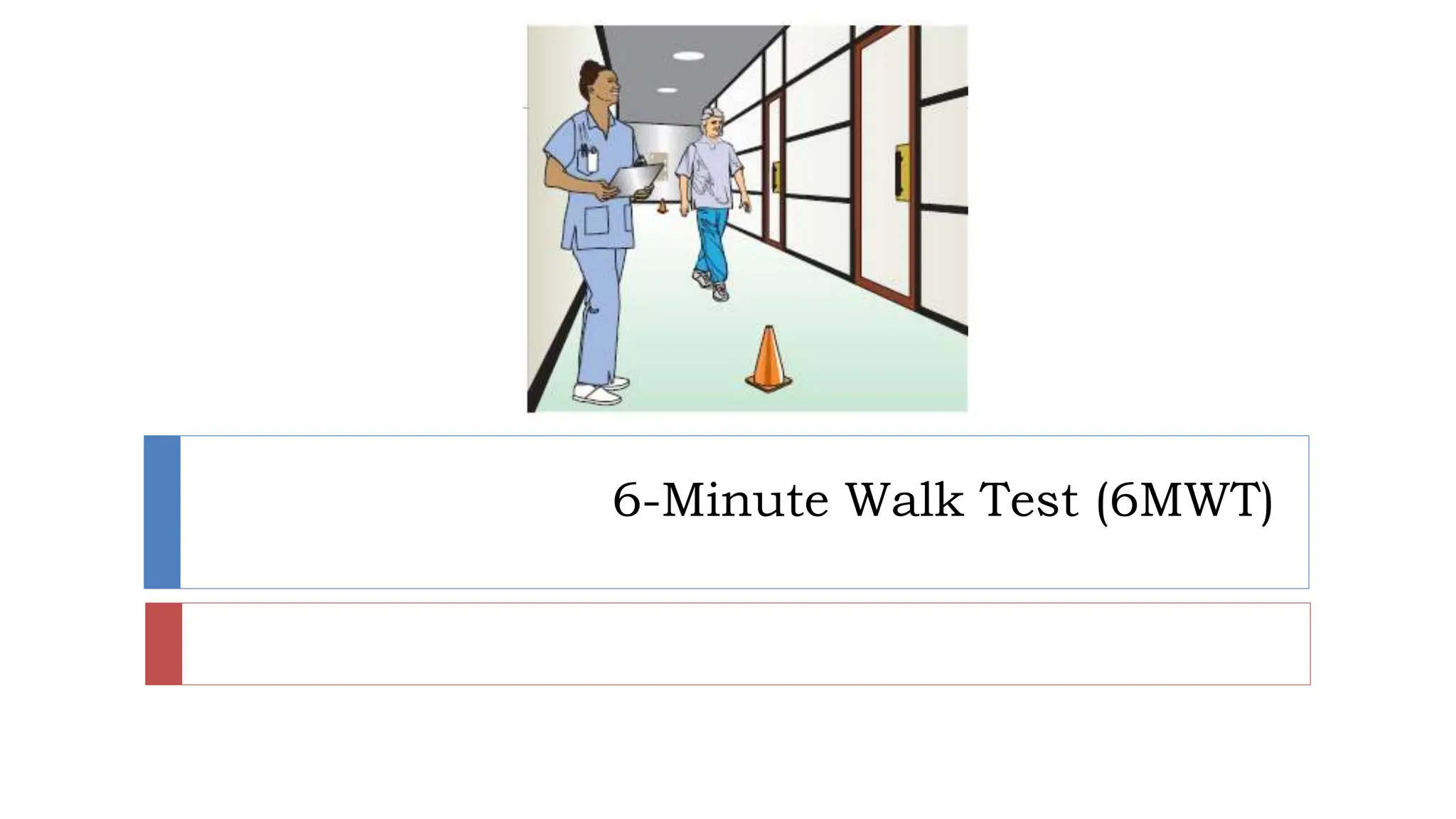
The 6MWT measures the total distance (in meters) a patient can walk back and forth along a flat corridor in 6 minutes, at a self-selected, submaximal pace, with the option to slow down, stop, or rest as needed.
6. Standardized Test Setup
Environment
• Flat, straight corridor (preferred length: 30 meters)
• Clearly marked turnaround points
• Minimal foot traffic and distractions
Equipment Required
• Measuring tape or pre-measured corridor
• Stopwatch
• Cones or tape for turnaround points
• Chair (for rest if needed)
• Pulse oximeter
• Blood pressure monitor
• Borg RPE and dyspnea scales
Consistency of setup is critical for reliable reassessment.
7. Pre-Test Preparation
Step 1: Patient Screening
Check for:
• Contraindications
• Recent symptoms (chest pain, dizziness)
• Appropriate footwear and assistive devices
Step 2: Baseline Measurements
Record:
• Heart rate
• Blood pressure
• Oxygen saturation
• Borg RPE (resting)
• Dyspnea score (if applicable)
Step 3: Standardized Instructions
Use standardized wording:
“The goal is to walk as far as possible for six minutes. You may slow down, stop, or rest if you need to, but please resume walking as soon as you are able.”
Avoid motivational coaching beyond standardized encouragement.
8. Step-by-Step Administration Procedure
Step 1: Start the Test
• Start the stopwatch
• Instruct the patient to begin walking
Step 2: Standardized Encouragement
Provide encouragement at set intervals (e.g., every minute):
• “You are doing well.”
• “Keep up the good work.”
Avoid pacing or pushing the patient.
Step 3: Monitoring During the Test
Observe:
• Gait quality
• Signs of distress
• Oxygen desaturation
• Excessive fatigue
Stop the test if safety concerns arise.
Step 4: Completion
• Stop the test at exactly 6 minutes
• Instruct the patient to stop where they are
9. Post-Test Measurements
Immediately record:
• Total distance walked (meters)
• Heart rate
• Oxygen saturation
• Blood pressure
• Borg RPE and dyspnea
Document any:
• Rest breaks
• Use of assistive devices
• Symptoms experienced
10. Scoring and Documentation
Primary Outcome
• Total distance walked (meters)
Additional Documentation
• Rest duration and frequency
• Assistive device use
• Symptoms and safety events
Example:
“6MWT: 320 m, single rest break (30 sec), SpO₂ dropped from 96% to 90%.”
11. Interpretation of Results
General Interpretation
• Longer distance = better functional capacity
• Compare results with:
– Baseline values
– Predicted norms (when appropriate)
– Previous reassessments
Absolute distance is often more clinically meaningful than percent predicted in rehabilitation settings.
12. Reliability of the 6MWT
Test–Retest Reliability
• ICC values: 0.90–0.98 across cardiopulmonary and neurological populations
Inter-Rater Reliability
• High when standardized protocols are followed
Clinical implication:
Changes in distance are highly likely to represent true functional change.
13. Validity of the 6MWT
Construct Validity
• Moderate to strong correlation with:
– VO₂ peak
– Gait speed
– Functional mobility measures
Correlation coefficients typically range from 0.60 to 0.80.
Predictive Validity
• Strong predictor of:
– Morbidity and mortality in cardiac and pulmonary disease
– Hospitalization risk
– Functional independence
14. Responsiveness and MCID
Responsiveness
The 6MWT is responsive to:
• Aerobic training
• Gait and endurance training
• Pulmonary and cardiac rehabilitation
Minimal Clinically Important Difference (MCID)
Reported MCID values:
• COPD: ≈25–35 meters
• Cardiac populations: ≈30–45 meters
• Stroke and older adults: ≈34–50 meters
Improvements exceeding these thresholds are considered clinically meaningful.
15. Clinical Decision-Making Using the 6MWT
6MWT results inform:
• Aerobic exercise prescription
• Progression of walking endurance
• Need for supplemental oxygen
• Discharge readiness and community ambulation safety
Examples:
• Low baseline distance → interval walking program
• Significant desaturation → oxygen titration and pacing
• Improving distance with stable vitals → progress intensity
16. SOAP-Based Documentation Example
S:
Patient reports early fatigue during community walking.
O:
6MWT: 280 m; SpO₂ decreased from 95% to 89%; Borg RPE 15.
A:
Reduced functional exercise capacity with exertional desaturation.
P:
Initiate graded walking endurance program with monitoring. Reassess 6MWT in 3 weeks.
17. Reassessment and Outcome Tracking
Recommended reassessment:
• Every 3–4 weeks in active rehab
• Post-program completion
• At discharge or transition of care
Ensure identical corridor length and instructions at each reassessment.
18. Advantages and Limitations
Advantages
• Simple and low-cost
• Strong reliability and validity
• Reflects real-world walking capacity
• Applicable across diagnoses
Limitations
• Requires adequate corridor space
• Influenced by motivation and learning effect
• Submaximal—does not assess peak capacity
19. Key Clinical Takeaways
• The 6MWT is a gold-standard functional endurance test
• Measures integrated cardiopulmonary and functional capacity
• Demonstrates excellent reliability and validity
• MCID typically ranges from 25–50 meters
• Essential for aerobic training prescription and outcome tracking
20. Key Literature References
- ATS Committee on Proficiency Standards for Clinical Pulmonary Function Laboratories. ATS statement: Guidelines for the six-minute walk test. American Journal of Respiratory and Critical Care Medicine. 2002;166(1):111–117.
- Enright PL. The six-minute walk test. Respiratory Care. 2003;48(8):783–785.
- Bohannon RW, Crouch R. Minimal clinically important difference for change in 6-minute walk test distance of adults with pathology: A systematic review. Journal of Evaluation in Clinical Practice. 2017;23(2):377–381.
- Holland AE, Spruit MA, Troosters T, et al. An official European Respiratory Society/American Thoracic Society technical standard: Field walking tests in chronic respiratory disease. European Respiratory Journal. 2014;44(6):1428–1446.
- Flansbjer UB, et al. Reliability of gait performance tests in men and women with hemiparesis after stroke. Journal of Rehabilitation Medicine. 2005;37(2):75–82.